The Corporate Event Production Checklist: A Guide to Smoother Events
From defining objectives to building a run of show and preparing presenters, this corporate event production checklist outlines the key steps that help turn complex events into seamless experiences.

Scott Dupre
//
Business Development Manager

Successful corporate events rarely happen by accident. Attendees walk into a ballroom, find their seats, and (hopefully) experience what appears to be a seamless program. What they don't see are the months of planning, coordination, problem solving, and preparation that made that experience possible.
After more than 35 years in event production, we've learned that great events are the result of having a plan, paying attention to details, and working with the right partners.
Whether you're planning a sales kickoff, leadership summit, product launch, or annual conference, this checklist will help keep your event on track and help you avoid unnecessary surprises along the way.
Start with Your Objectives
Before discussing stage designs, video walls, lighting packages, or room layouts, take time to define what success looks like.
You should know:
What is the purpose of this event?
What message are we trying to communicate?
What should attendees feel, learn, or do afterward?
Your production decisions should support those goals.
A sales kickoff may benefit from high energy entrances, dynamic lighting, and impactful walk on moments. A leadership meeting may require a more polished, focused environment with flawless presentation support and audience interaction. A product launch may call for theatrical reveals and immersive visual storytelling.
The most effective production plans start with clearly defined objectives.
Understand the Venue Early
Every venue has unique opportunities and limitations.
One of the most common mistakes planners make is assuming that a ballroom is simply a ballroom. In reality, loading access, ceiling heights, power availability, rigging capabilities, and labor requirements can all significantly impact both budget and execution.
Whenever possible:
Schedule a site visit with your production team.
Review loading dock access and load in procedures.
Verify rigging and power capabilities.
Identify any venue specific labor requirements.
Confirm restrictions on outside vendors or equipment.
The earlier these conversations happen, the fewer surprises you'll encounter during production week.
Build a Realistic Timeline
The earlier your production team is involved, the more options you'll have. A typical planning
timeline might look like this:
6-12 Months Out
Secure venue and event dates.
Establish budget parameters.
Select your production partner.
Begin high level creative discussions.
3-6 Months Out
Finalize room layouts and scenic concepts.
Develop technical plans.
Confirm speaker and presenter requirements.
Review audience experience and engagement strategies.
1-3 Months Out
Build the initial run of show.
Collect presentation materials.
Finalize production schedules.
Confirm staffing and logistics.
Final 30 Days
Conduct production meetings.
Finalize presentations and media assets.
Schedule rehearsals.
Review contingency plans and backup procedures.
The more preparation completed in advance, the more smoothly the show week tends to run.
Create a Detailed Run of Show
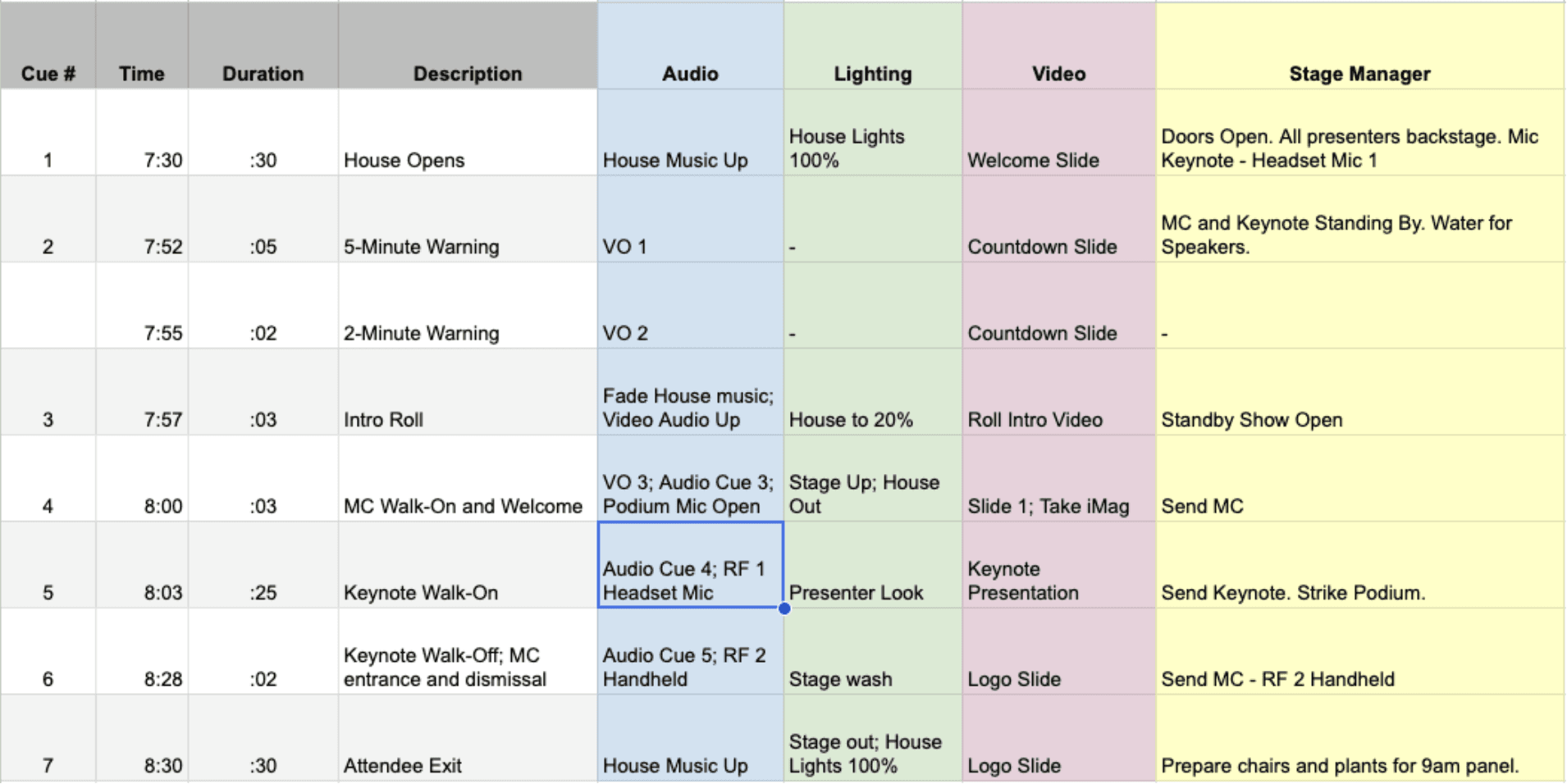
A Run of Show is one of the most important documents you'll create. It serves as the roadmap
for presenters, technicians, stage managers, producers, and event staff.
A strong run of show should clearly outline:
Timing of each segment
Presenter entrances and exits
Video playback cues
Lighting transitions
Audio requirements
Stage changes
Breaks and room resets
The more detailed the document, the easier it becomes for every team member to stay aligned
throughout the event. Below is an Example Run of Show.
Prepare Your Presenters for Success
Even experienced speakers benefit from preparation. Build time into your schedule for:
Technical rehearsals
Presentation reviews
Microphone testing
Confidence monitor and teleprompter checks
Stage walks
Encourage presenters to submit slides early and establish firm deadlines for presentation materials. Last minute changes are inevitable, but reducing them whenever possible helps prevent unnecessary stress for everyone involved.
Most importantly, give presenters an opportunity to become comfortable with the space before attendees arrive.
Remember the Human Element
Corporate events involve more people than most attendees ever realize. Venue staff, production crew, security teams, catering managers, facility personnel, and decorators all play important roles in creating a successful event.Kindness and mutual respect often make a significant difference behind the scenes. The most successful events happen when everyone involved is working toward the same goal and communicating effectively with one another.
Technology matters. Logistics matter. But people remain the most important part of any event.
Final Thoughts
A successful corporate event shouldn't feel like a crisis narrowly avoided. With thoughtful planning, realistic timelines, clear communication, and the right production partner, event day becomes far less stressful, and dare I say, enjoyable?
Our goal is to create an experience that supports your objectives, engages your audience, leaves attendees with a positive, lasting impression, and to have fun while doing it.
When preparation and execution come together, that's exactly what happens.
More ARTICLES.
Explore our collection of insights, from quick, actionable tips to in depth explorations of design, development, and the evolving world of live production.

